
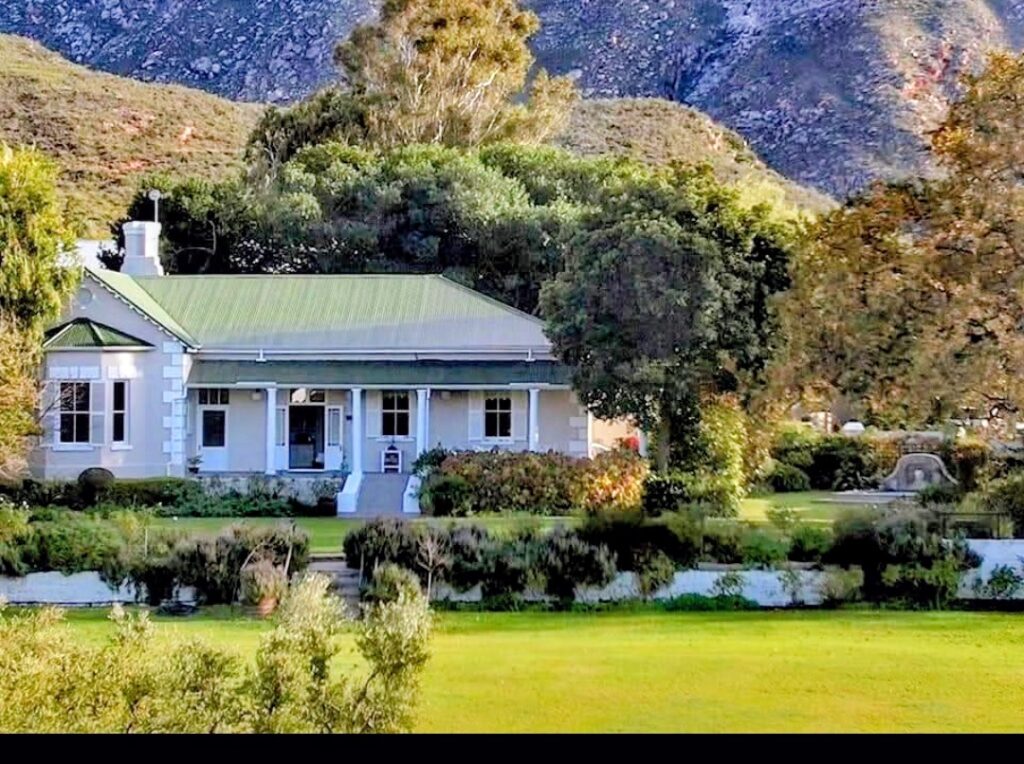
2 TANNER STREET – FAIRVIEW / MONTAGU VINES
Standing prominently in Tanner Street, Montagu Vines is one of the notable early twentieth-century homes that contributed to the development of Montagu West as a prosperous residential area. Originally known as Fairview, the house was commissioned around 1908 by farmer David Jacob Burger (1879–1954) and his wife, Hendrina Margaretha Burger (1878–1946). The building was constructed by respected local builder Willem Richard van As (1866–1934), whose work helped shape much of Montagu’s architectural character during this period.
The property represents a period of confidence and growth in Montagu’s history. By the beginning of the twentieth century, improved transport routes, expanding agricultural production, and increasing prosperity enabled successful farming families to invest in substantial town residences. Fairview was one such home, designed as an asymmetrical villa reflecting the Victorian influences that remained popular in the Cape countryside during this era.
The house was closely associated with the Burger family for many decades. Both David Jacob Burger and his father, also named David Jacob Burger (1840–1933), died at Fairview, giving the property a strong connection to several generations of one of the district’s farming families.
Like many historic homes, Fairview’s story is also told through the succession of families who occupied it. Among its later owners were Walter James Whitehead and his wife Johanna Aletta Whitehead, née Knipe. Walter Whitehead played a significant role in the agricultural economy of the region, serving as Deputy General Manager of the Langeberg Canning Factory in Ashton between 1940 and 1961. He later established the Suikerbekkie enterprise, producing marzipan and almond essence from apricot pips and exporting canned and glazed fruit, reflecting the importance of the deciduous fruit industry to the Langeberg region.
The property was subsequently owned by artist Raymond Andrews and his wife Uta. Andrews, a respected South African artist who studied under influential figures including Jack Lugg and Cecil Skotnes and later worked with Walter Battiss, brought a creative dimension to the history of the house. His career in graphic arts and wood-panel engraving linked the property to South Africa’s rich artistic heritage.
Memories recorded by long-time Montagu residents reveal that the property remained a familiar landmark within the community. Local recollections place John and Bess Kriel at the property during the late 1950s, while later residents remembered members of the Bouwer family associated with the house. These personal memories provide a valuable glimpse into the social history of the property and the everyday lives connected to it. A significant new chapter began when Richard and Beverley Ilett acquired the property in 2006 and established Montagu Vines as a guesthouse and small vineyard. Under their stewardship, the property was adapted for hospitality while retaining the architectural qualities that make it an important contributor to Montagu’s historic conservation area. The house was described as reflecting the early Victorian-influenced Karoo style that characterised many substantial homes built between 1900 and 1910.
Today, Montagu Vines remains a reminder of Montagu’s agricultural prosperity, its architectural heritage, and the generations of families who have called this remarkable property home. From its origins as Fairview, commissioned by a prominent farming family, to its present role welcoming visitors to Montagu, the house continues to form an important part of the town’s historical and cultural landscape.
